Ontario is falling short when it comes to its efforts to connect Ontarians with primary care and to check that doctors are not overbilling, the province’s auditor general says.
Auditor General Shelley Spence released her annual report at Queen’s Park Tuesday. Weighing in at 483 pages, the report takes aim at primary care, OHIP billing, government advertising, how the province manages its PPE supply and more.
‘Shocking’: OHIP not flagging questionable billings
The auditor found that the Ministry of Health’s claims system has limited functionality when it comes to detecting “high-risk billings” by doctors.
“Our analysis of fee-for-service (FFS) billings data between 2021/22 and 2024/25 found numerous examples of physicians who billed for over 24 hours of services in a single day; provided services to an unusually high number of patients (for example, over 100) per day; or worked a high number of days (for example, 365) in a year,” Spence wrote.
She found the ministry primarily relies on tips and complaints instead of using proactive data analysis to identify questionable billings.
Despite having launched a claims modernization initiative in 2023, Spence said, the government’s lack of progress on the initiative has led to delays in realizing the benefits of such a system.
“I think if you look at the figure where we put the physicians that were billing all of those categories – more than 24 (hours) a day, more than 365 (days) a year, higher than all of their peers, and higher than the 90th percentile of their peers – those were all very shocking to me,” Spence told reporters.
Examples of high-risk billings the government didn’t audit include an ophthalmologist who billed $6.7 million in 2023/24 – more than twice as much as the next highest-billing ophthalmologist. Spence also flagged a diagnostic radiologist who reported working 364 or more days in each year from 2021/22 to 2023/24 and billed $3 million in 2023/24 alone.
“I don’t know if a physician was billing everything on Friday for the week and just didn’t date it properly. I mean, that’s the reason why they need to go in and do investigations,” Spence said. “Are they billing for nurse practitioners doing work when under their name, when it’s actually the another doctor or another nurse in their clinic?
“So there’s lots of reasons why this could be high, but the point is, the ministry should be looking into those and seeing what those reasons are.”
A 2019 joint working group composed of members from the Ministry of Health and the Ontario Medical Association (OMA) identified roughly $480 million that could be made in annual reductions by limiting the use of medically unnecessary services. However the ministry estimated that as of 2024/25, just $87 million of reductions had been realized.
The group found that cutting excessive injections for chronic pain would result in $100 million worth of cost reductions annually. But in 2024/25, the auditor found, claims data showed the top 10 billing physicians who provided pain management each billed between $4.3 and $9.9 million, for a combined total of almost $60 million.
Spence found there are also limited resources made available to detect inappropriate billings.
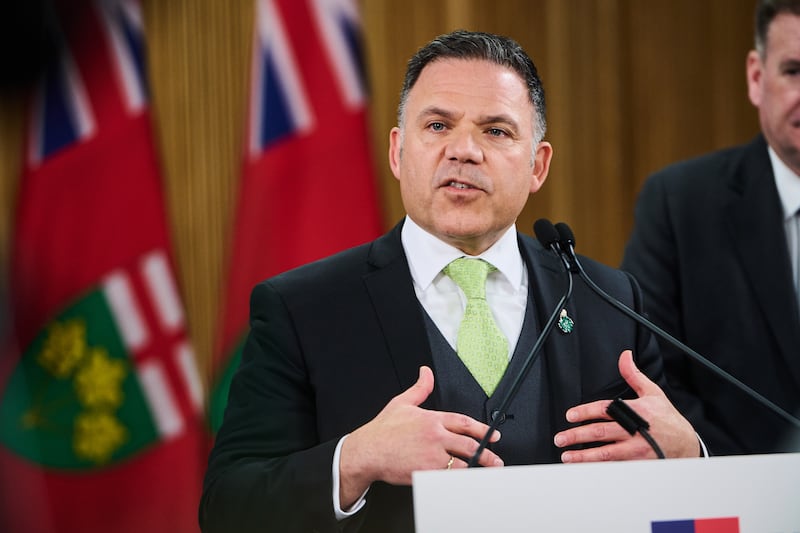
Anthony Leardi, parliamentary assistant to the minister of health, responded to the report on behalf of the government.
Leardi became testy when questioned about the overbilling, saying he believes the government has 99 per cent compliance for the 200 million or so bills that come through OHIP each year.
“Normal is the word you’ve used. I have not used that word. It is an exceptional situation,” Leardi said when asked by a reporter if it’s normal to bill 24 hours in a single day.
He said a physician could potentially bill for various overlapping treatments if they see a patient with multiple issues, resulting in additional hours.
A spokesperson for Premier Doug Ford’s office said all the cases of questionable billing flagged by Spence are now being investigated.
But NDP Leader Marit Stiles said the issue has more to do with a lack of government oversight than potential overbilling by a few individual doctors.
“This isn’t really about the individual doctors, as much as it is about the fact that the government refuses to put enough people in charge of monitoring these things, and also about the slide into privatization of our healthcare system,” Stiles told reporters.
She called it “bananas” that the government has just eight people responsible for looking into cases of overbilling at OHIP.
‘No consistent plan’ for connecting to primary care
When it comes to finding a family doctor, Spence found multiple problems with the Ministry of Health’s performance.
“Our audit concluded that the Ministry, in conjunction with Ontario Health, did not consistently have processes in place to plan and oversee programs and initiatives to improve patients’ access to primary care,” Spence wrote.
She found the Health Care Connect (HCC) system, which is meant to connect people with family doctors, has not fully met the needs of Ontarians trying to find a primary care provider.
As of June 2025, there were 178,000 people on the system waiting to be referred to a family physician. Of those, 108,000 had been waiting for longer than a year, including roughly 5,000 people with complex health needs.
Spence also found wide variation in wait times on the system. Of the 197,000 people referred to a primary care doctor between the 2020/2021 fiscal year and April 2025, 47 per cent waited fewer than 21 days, while 15 per cent waited more than 260 days.
About a year ago, 12 family health teams told the Ministry of Health that they no longer support the use of the HCC, saying the tool released in 2009 is “no longer fit for purpose.”
The auditor also found that the government has not updated its communication plan for the HCC since 2015, a fact that could help explain why only 235,000 Ontarians – an estimated 11 per cent of Ontarians known to be without a family doctor –are registered on the site.
While the province has tasked 58 Primary Care Networks with organizing regional primary care delivery, it has not granted them the authority to require primary care providers to work with them.
“As a result, the Networks have varying levels of understanding of how many providers practise primary care in their communities,” Spence wrote. “This increases the risk that Networks cannot effectively achieve the Province’s Primary Care Action Team (PCAT) goal of 100% attachment to primary care by 2029 as they are not aware of how many providers currently practise.”
Earlier this year the Ford government announced a Primary Care Action Plan – a $1.8 billion plan to connect every Ontarian with primary care within four years.
But when it comes to measuring the progress of that plan, Spence says the government has not established timelines and targets for measuring key performance indicators.
Spence made 11 recommendations about how to better connect Ontarians with primary care and the government has accepted all of them.
Still, Leardi said the province is making progress at connecting people with primary care.
“The number of people on that waiting list has actually been greatly reduced,” he said. “It’s been virtually cut in half or more. We’re connecting more people to primary care in the province of Ontario than we’ve ever connected before.”
However Stiles said the lack of performance indicators shows the plan is not a serious one.
“How many times have we been promised they were going to address the shortage of family physicians,” she said. “And what we have here is proof that the primary care action plan is not a plan at all. It doesn’t exist.”
No consistent approach to plan for medical school expansion
The auditor also found issues with Ontario’s expansion of medical school spots.
The province has said it wants adds 340 undergraduate and 551 postgraduate medical school seats. Of the new seats expected to be added by the 2028/29 academic year, 60 per cent are expected to be dedicated to family medicine.
However the auditor found that the government did not document an analysis of key considerations to support their expansion plans, failing to provide a justification for the most appropriate number of seats to add, the proportion of seats allocated to family medicine, and evaluation of the medical schools’ capacity to implement the expansion.
Specifically, the ministries did not fully assess the need to open two new medical schools, failing to consider the option of expanding capacity at existing medical schools. Nor did they use a forecast model to estimate the supply and demand of family physicians.
Spence wrote the government “did not demonstrate that their decisions to increase the number of medical school seats and their allocation across all medical schools, including establishing two new medical schools, were based on comprehensive analysis.”
Medical schools also rolled out 89 fewer (44 per cent) family medicine seats by 2025 than planned due to a lack of family physician training sites.
Spence said the Ministry of Health also lacks a framework to assess whether medical school seat expansion is making it easier to access a family doctor.
Leardi said Tuesday that the government’s plan is nevertheless still increasing the number of doctors graduating.
“The actual number of people graduating from medical schools has actually increased by 30 per cent and that’s great. We have more people graduating than we did before,” he said.
PPE not properly tracked
When it comes to the province’s supply and management of personal protective equipment (PPE), the auditor says Ontario has written off more than $1.4 billion worth of PPE since 2021.
She found the government has still not yet fully implemented previous recommendations around PPE from 2022 and 2023.
At the time, the auditor found numerous issues stemming from human error in tracking PPE supplies, such as protective masks, gowns, gloves, hand sanitizers, wipes and disinfectants.
Supply Ontario was established in 2023 to address the issues, but the auditor says problems persist.
“To date, we have not seen evidence of an integrated perpetual inventory system for PPE that tracks both quantities and costs,” the auditor wrote. “Supply Ontario has indicated that inventory integration will take place once a new third-party logistics contract is fully implemented.”
The auditor noted the agency has signed a new agreement and began the process of consolidating its inventory with that provider in September.
However the auditor noted that she has not yet been able to complete a full audit of Supply Ontario due to “continued delays” in receiving documents from them, as well as some of their methods.
“The manual tracking of inventory and the timing of Supply Ontario’s valuation process continued to present challenges in determining the valuation of PPE. It required significant time and effort to determine the year-end values and to audit them,” she wrote.